
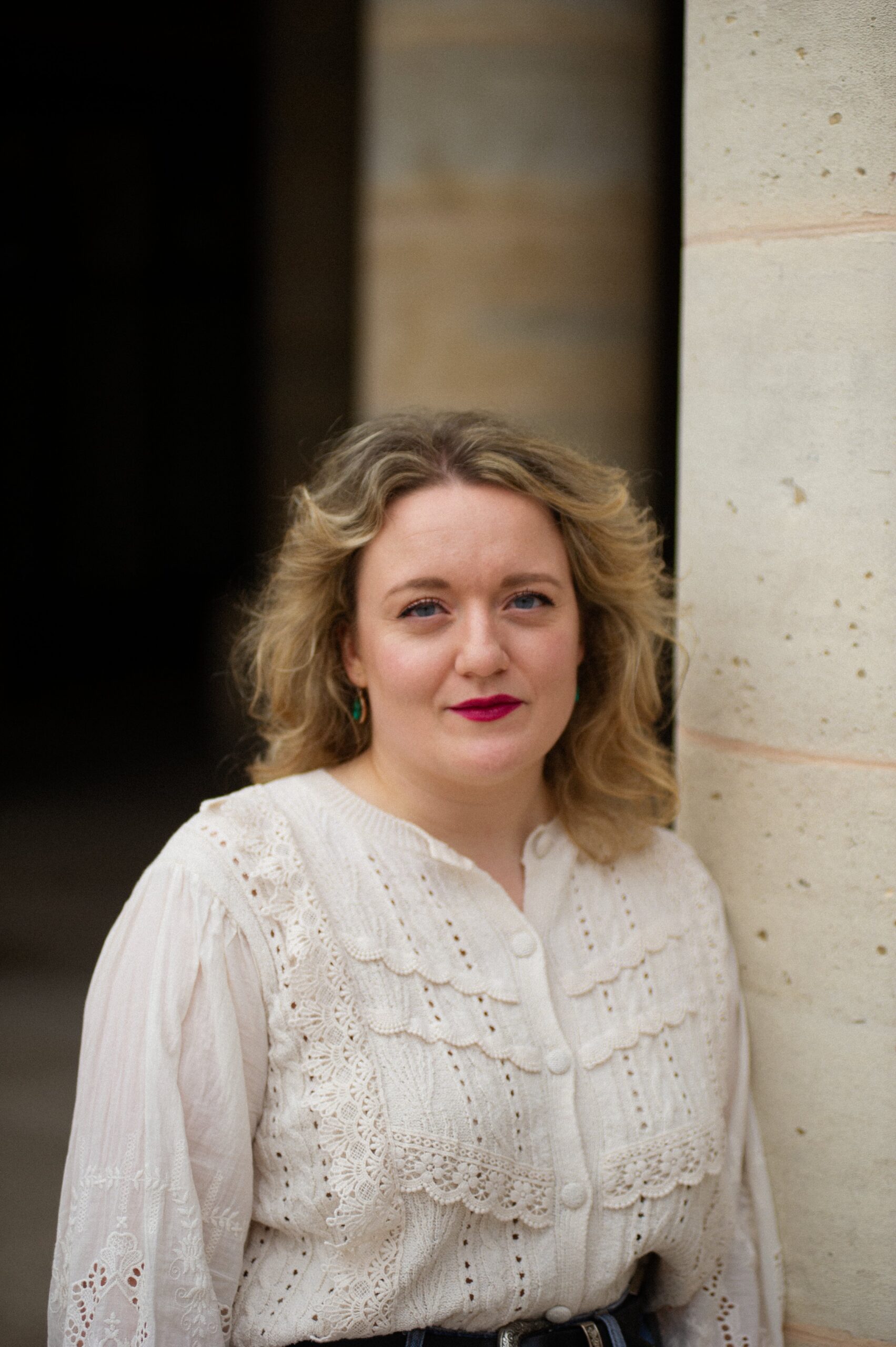
Fanny Utiger
During our student years, my friends and I also tried, on our own scale, to fight against sexual and psychological harassment and against the sexist prejudices prevalent in the classical music world (and by extension at the Conservatory). It’s a long-term struggle that’s difficult to lead as students, both because of our status and because we’re only passing through training institutions (five or six years is ultimately quite short), but I’m proud to have tried to move things forward with my peers.
I started singing by chance, joining an amateur choir for fun at age 23. But from the very first rehearsal I realized that the vibrations of singing, both my own and those around me, had been missing from my whole life without me knowing it.
One thing led to another, I took singing lessons, and while I was waiting to hear about funding for a doctoral thesis, I made myself a promise I told no one about: if I didn’t get that funding on the first try, I would switch to singing. I didn’t get the funding, and the rest is history… It was a completely crazy decision, I hadn’t even been singing for six months. I suppose I had the fire in me. But in fact I also felt like I was finding myself again: after spending my whole childhood and adolescence doing dance, I had stopped all artistic activity during my university studies, even though my passion for the performing arts had never left me. By starting to sing, I rediscovered art and found that it was through the lyric voice that I was called to express myself in life. In the end, while I innocently wanted to pass the time, I lifted the veil on my calling… There’s still a long way to go, but looking back gives me confidence.
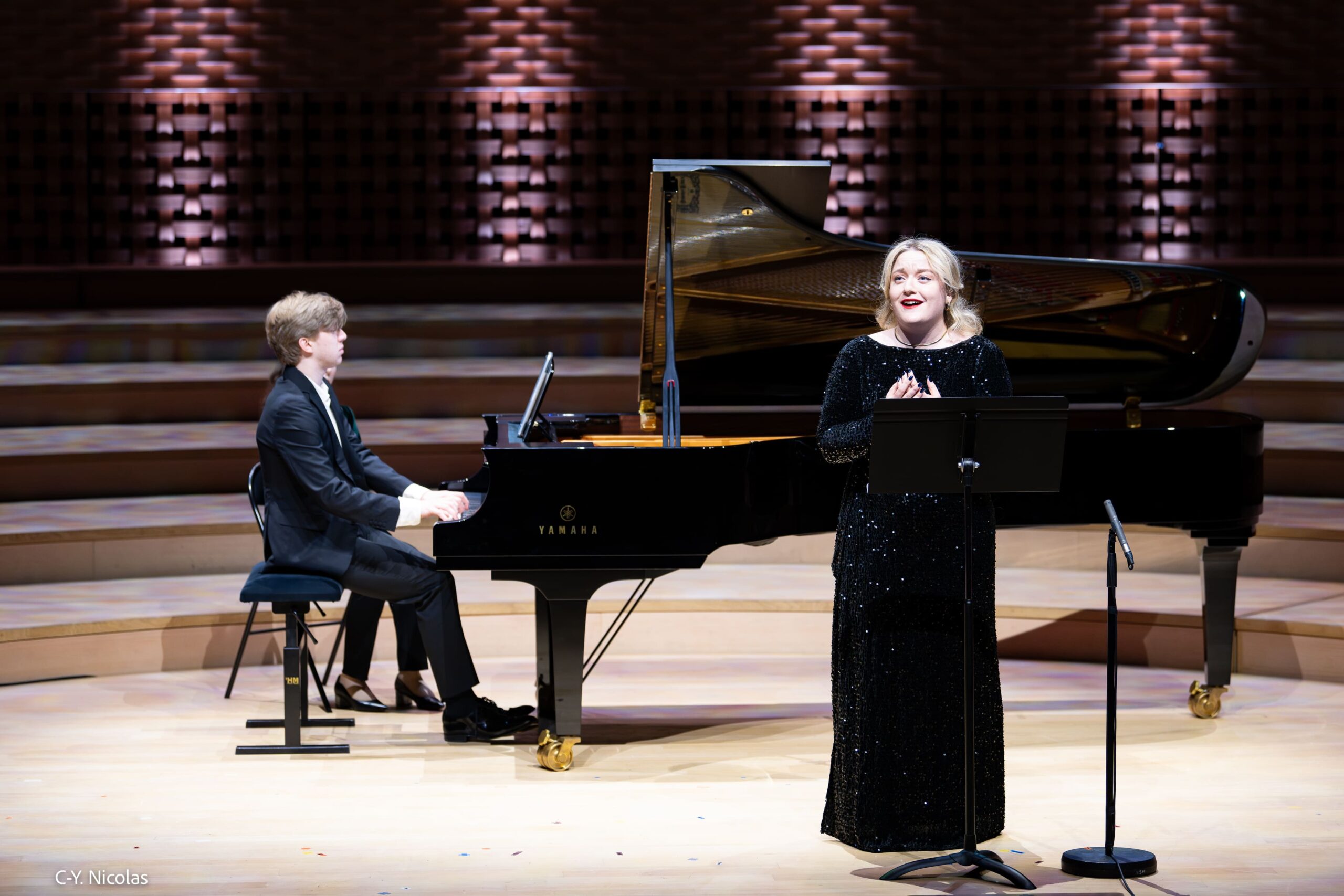
Beyond that, it’s clear that the analytical tools I kept from university let me dive easily into the texts of the works I sing. I also retain the same love of language and poetic expression, but music offers me even more richness in that respect thanks to the plurality of languages, and few texts move me as much as the German poems chosen by Germanic composers. I also did a lot of analysis of plays at university, and that brings me a lot for the stage, especially because seeing a lot of contemporary theater opened my mind: I’m truly curious about all kinds of staging today. I like contemporary productions because, even when they’re scandalous, they keep opera alive: they make us react and therefore form an opinion and a discourse about this art form.
Socially, many romantic heroines interest me a great deal too. If we take Puccini as an example, his female characters are always at the intersection of several oppressions. They are women, on one hand, but on the other: Mimì is a grisette, poor and on the edge of the street, Cio-Cio San is a single, underage mother, racialized in the face of an American colonizer, Tosca is an opera singer (diva or not, it’s a status associated with courtesans and therefore not very respectable in the 1800s). And those are just the best-known examples. They all die at the end, which is also a subject in itself (except Minnie in La Fanciulla, but she’s a fascinating character, a spinster who teaches cowboys and then saves the life of her fugitive lover), but Puccini’s narrative, and that of his librettists, is systematically on their side, and all the pathos of the work works to sensitize audiences to these women’s situations, to win them over to their cause. It’s a subject I’m passionate about, and as a singer this angle of interpretation is decisive for me.
The work of exploring the repertoire of women composers is booming, and much more developed than it was even four or five years ago. It’s an absolutely necessary process, and I’m glad to see a canon beginning to form, where certain pieces are (rightfully) establishing themselves as masterpieces. I’m thinking, for example, of Rita Strohl’s Chants de Bilitis, which have already been recorded twice, of Mel Bonis’s Femmes de légende, or of Dora Pejačević’s Symphony in F-sharp minor. For voice, one of my favorite works is Marie Jaëll’s cycle of 5 Lieder, which is an absolute masterpiece, but which isn’t yet really recognized as such. One of my dreams is to record it and commit to disc the interpretation Léa Lefèvre and I have been working on for nearly two years now.
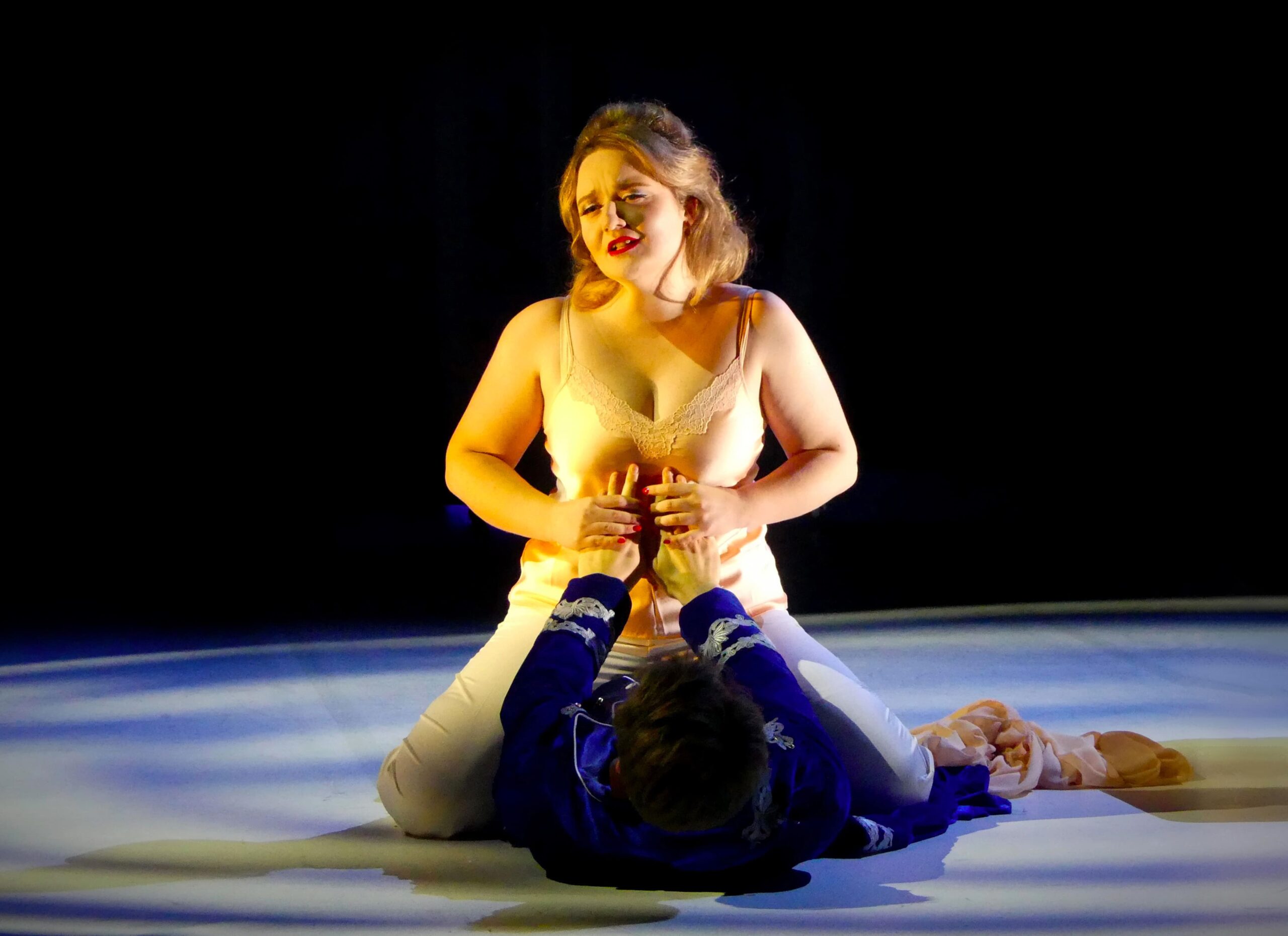
Among the most striking moments on stage was the final scene. This time, playing Mathilde, I sang almost the entirety of the Salve Regina: it’s an indescribable experience of music and sisterhood. The blows of the guillotine make our blood run cold (backstage, it’s an actual machete that the percussionist brings down along a metal bar and against a wooden block), and you have to keep singing while feeling your sisters moving away into the darkness. I made the choice not to detach myself from the situation and to live it fully, even if it meant singing while crying.
You recently took part in Lied the Way, a collective of women musicians exploring new ways of sharing the Lied: what did this experience bring you, artistically and personally?
I came away from it very inspired, because I was given confidence, because I made wonderful connections, brilliant women, and because I received both concrete solutions to move my career forward and a certain perspective and connection with a less cerebral side of my personality that I don’t always make enough use of. I came back from Florence completely reenergized after this week surrounded by women, where we worked with one another while trying to keep the spirit of competition as far from us as possible.
Every path is different, and I imagine we’re not all musicians for the same reasons. I would tell someone who feels the same drive I do for this profession to do everything possible to give themselves the means to pursue it, and, whatever happens, not to have regrets.
Concretely, you need to know how to surround yourself with the right people—people who are competent, demanding, and who wish you well. That last point is non-negotiable. Today, there are still too many toxic, possessive, and competitive teachers. If I had to give only one piece of advice, it would be to build a caring team around yourself (teachers, mentors, pianists, an agent when the time comes). The working world takes care of being hard on us soon enough on its own; if the people around us are hard on us too, we’re far too vulnerable and far less inclined to assert ourselves.
My second piece of advice is to listen to as much music as possible, from old recordings to new productions in the theaters and halls you have access to. You have to form your own opinion and aesthetic to know exactly what you want to say ; that’s also what gives meaning to all the effort you put in.
Now, you shouldn’t be blind to the real cost of this career: I’m a workaholic, and I was able to progress very quickly, but none of that would have been possible without my parents’ financial support. Not everyone has that kind of luck. I worked to earn money alongside my studies, but never at the expense of my studies or of my mental and physical health. I have too many friends who can’t say the same, and that’s unfair. So I can only repeat my first piece of advice: surround yourself well.
However, today, being an opera singer is still a matter of choosing to lead an existence that runs counter to what capitalist society demands of us: we produce nothing, we merely interrupt everyday life for the length of a concert or an opera, we keep works of the mind alive, and we communicate through emotion. For me, nothing compares to the performing arts. There’s nothing more beautiful than seeing women and men on stage bring works to life live, whether they come from the canon or have just been written.
I still find it quite difficult, though, to become politically engaged as a young classical musician. While I believe artists should be able to speak out in the public sphere and offer their sensitive perspective, our professional situation is so difficult and competitive (and our field still so often reactionary) that, at the stage I’m at, I’m always careful about what I say in the working world. Still, I tell myself that, for now, having chosen to persevere in this profession in these times is already a form of commitment.
One of the projects I’m most looking forward to this season is returning to Verdi’s Requiem, which will take place in June 2027 in Geneva. I sang my first run of this Requiem in November 2025, and I hope to sing it every season and grow with this work, which is truly dear to me.
I of course have several recital projects, always balancing between my program of German Romantic Lieder and that of women composers. And this year, fresh out of school, is also the year of competitions and auditions. In the immediate future, I’ve been selected for two competitions taking place in September 2026, including the Concours Renata Tebaldi. I’m really looking forward to attending this competition, founded in the legacy of one of the greatest sopranos of the 20th century, a woman who inspires me enormously.
13/08/2026