

© Marielle Aubé Michèle
Michèle Bréant
Soprano
michelebreant.com
You recently performed the role of Sister Constance in Poulenc’s Dialogues des Carmélites. Could you tell us about this experience?
Sister Constance is a role I had long wanted to sing. It suits my tessitura very well, I feel extremely comfortable vocally, and the music is sublime. I also love singing in French: I feel very close to the text and its subtext, and I am particularly drawn to the sung sonorities of the language. Constance is a complex character — at once youthful, naïve, and deeply profound. Her connection to the divine makes her very confident and self-assured. She evolves on stage alongside Blanche, sung by Hélène Carpentier, who was truly inspiring. Dialogues des Carmélites is an intensely powerful and deeply moving work, and at times one must contain one’s emotions in order to continue singing properly, particularly in the final Salve Regina. This production was very demanding for us on stage, and the fact that it was so warmly received by the audience was immensely uplifting for all of us.
What remains within you once a production ends and you leave a role behind?
The experience of a role creates a kind of additional inner space, both vocally and interpretatively ; it offers a new perspective on the world. We embody facets of a character that do not necessarily exist within our own personality. I had my own vision of Constance, but the character was also shaped through the staging process, and if I were to perform the role again in a different production, it would undoubtedly be different. My teachers have always told me that the voice develops through roles. For example, I have sung Zerlina (Don Giovanni) frequently, a role that lies in the lower part of my tessitura, and I have felt a clear vocal evolution in that register, I am now much more comfortable there.
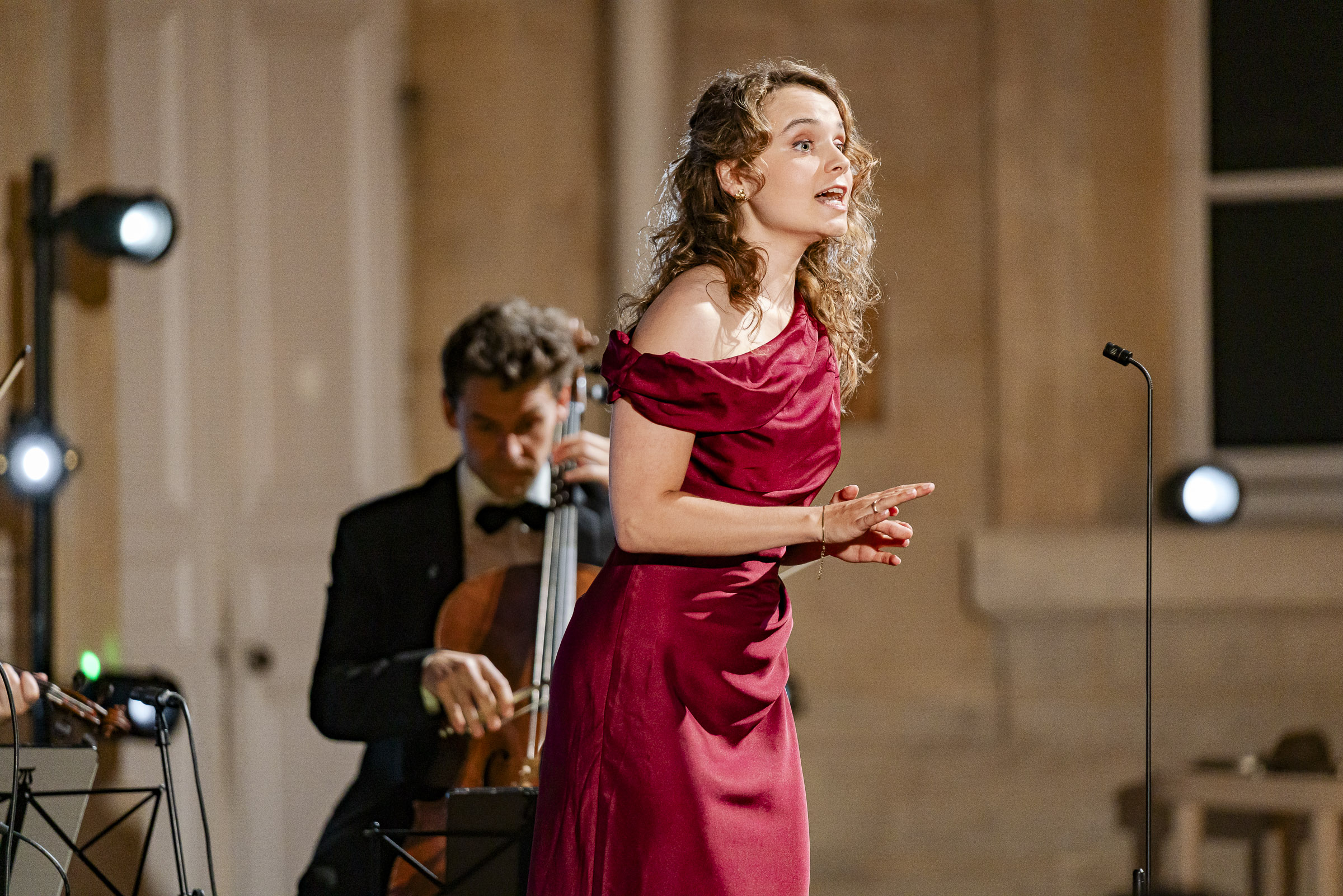
© Boris Bartel
Growing on stage, how does that shape the process of becoming an artist?
It is on stage that I learn the most. By listening to colleagues and to the orchestra, by engaging in dialogue with them. With experience, one develops a more familiar relationship with the stage ; it is no longer a place to be feared, where one must be “perfect,” but rather a space for exploration. Each performance is different, and it becomes a true place of sharing, both with fellow artists and with the audience.
You studied in Leipzig, what differences did you discover between the German and French approaches to singing and interpretation?
I truly learned how to sing in Germany. I arrived there at a very young age, and the Hochschule gave me the space to develop. The atmosphere was very different from what I had previously experienced – highly international and welcoming – and it allowed me to flourish both vocally and artistically. Vocal technique held a central place; it takes time to develop a voice. I was fortunate to study with exceptionally skilled teachers who taught me how to use my instrument in a healthy and sustainable way. I also discovered the fascinating world of Lied there, and speaking German fluently makes an enormous difference when approaching this repertoire.
How does your academic background in Literature and the Arts inform the way you approach music and the roles you perform today?
My studies in Literature and the Arts have given me a particular relationship to text. I always approach a role by seeking to understand the words, the context, and the character’s background in depth. Studying literature, as well as visual arts, art history, and cinema, has also nourished my imagination. It allows me to draw connections and to engage more deeply with staging, scenography, and visual concepts, by placing the role within a broader network of references. I would very much like to pursue these studies further with a Master’s degree, but for now I simply do not have the time.
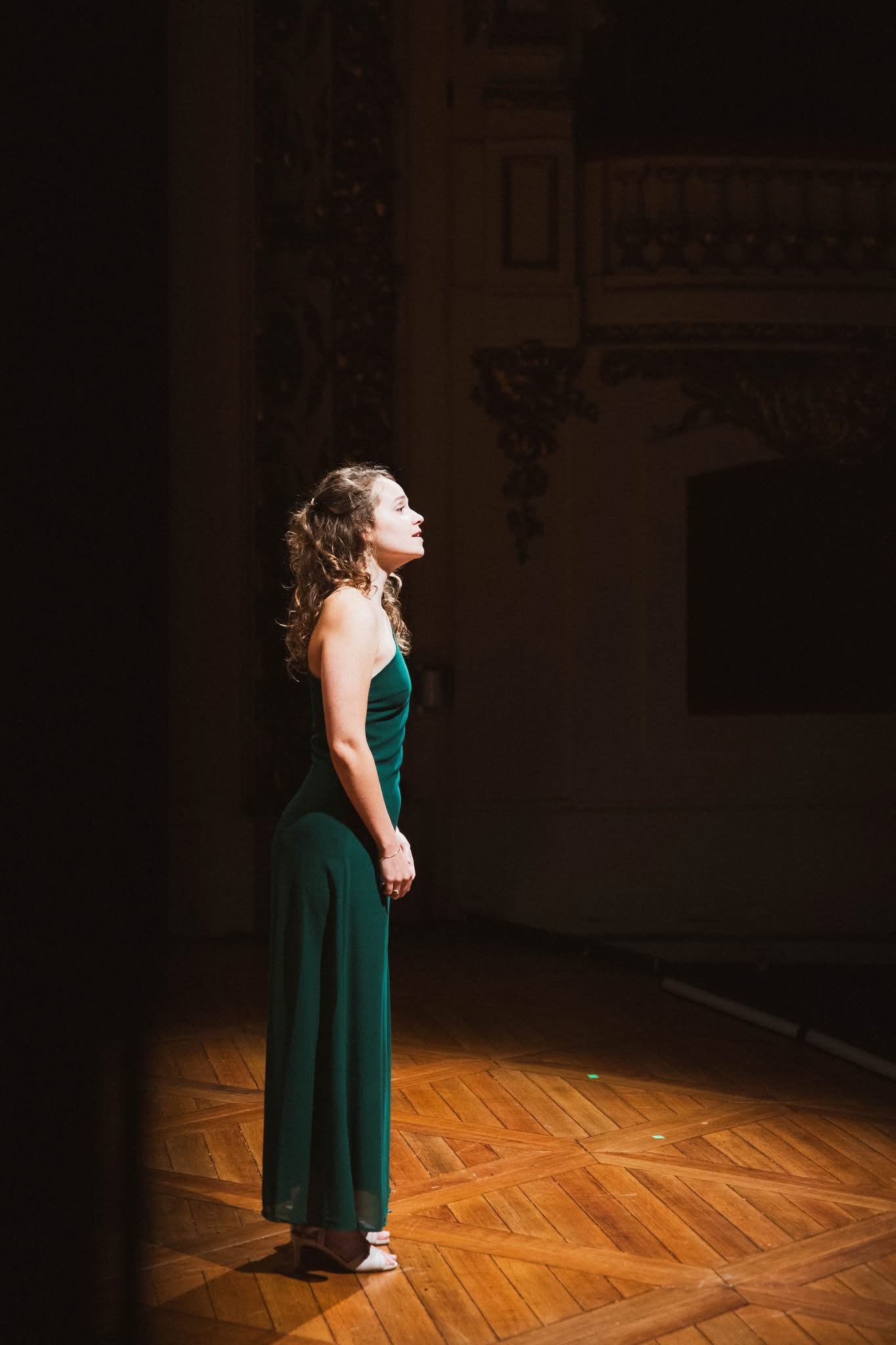
In recital, the relationship with the audience is more direct : how does this compare to performing on the opera stage?
It is a completely different experience. Recital can feel more exposed and, in some ways, more demanding than opera: there is no staging, no partners, no costumes, no set. The relationship becomes far more intimate, and one feels almost completely vulnerable in front of the audience. Vocally, it can also be more demanding, as one often sings continuously. At the same time, it is a great joy to perform with an orchestra or with a pianist. Recitalc and especially duo recital with piano, is something very special and moving, because one presents a programme that is often entirely personal: poems and music that resonate deeply, and that one shares directly with the audience.
As the voice evolves over the years, how do your repertoire choices evolve as well?
I am beginning to know my voice well, and the particular nature of my tessitura gives me a fairly clear sense of how it will evolve. I know that I will not become a mezzo-soprano or a dramatic soprano ; my voice remains light and coloratura, but it is gradually gaining depth and richness with time and experience. This allows me to approach the repertoire with patience and coherence. There are still many roles I would love to sing on stage, such as Blondchen or Sophie (Werther), before eventually approaching roles like the Queen of the Night, Lakmé, Ophélie, Sophie (Der Rosenkavalier), or Zerbinetta.

© Marielle Aubé Michèle
What does it mean to be an artist today, for you?
Being an artist today means practising a unique profession, one that requires both great rigour, solitude, and organisation. It demands deep commitment and discipline. But above all, it is an immense source of joy. The stage, the encounters, the travels, it is incredibly enriching. It is a profession in which one unites with others in the service of music, moving together in the same direction, at least for the duration of a concert or production, in order to offer and share this experience with the audience.
What are your upcoming projects?
I will be singing Mahler’s Symphony No. 4 for the first time with the Orchestre de Bordeaux at the end of February. I will then perform my first Leçons de Ténèbres by Couperin with Christophe Rousset, on tour in Rouen, Oslo, and at Salle Cortot. Before the summer, I will take part in a German tour of Rameau’s Pygmalion with the European Baroque Orchestra, and I will then sing Dalinda in Handel’s Ariodante at the Festival de Beaune, again under the baton of Christophe Rousset. Next season will include several role debuts, notably Flora in The Turn of the Screw and Servilia in La Clemenza di Tito, while continuing the tour of Don Giovanni.
21/02/2026